
An increasingly important source of health-related bibliographic content are preprints - preliminary versions of research articles that have yet to undergo peer review. The two preprint repositories most relevant to health-related sciences are medRxiv and bioRxiv, both of which are operated by the Cold Spring Harbor Laboratory.
The goal of the medrxivr R package is two-fold. In the
first instance, it provides programmatic access to the Cold Spring Harbour Laboratory (CSHL)
API, allowing users to easily download medRxiv and bioRxiv preprint
metadata (e.g. title, abstract, publication date, author list, etc) into
R. The package also provides access to a maintained static snapshot of
the medRxiv repository (see Data sources).
Secondly, medrxivr provides functions to search the
downloaded preprint records using regular expressions and Boolean logic,
as well as helper functions that allow users to export their search
results to a .BIB file for easy import to a reference manager and to
download the full-text PDFs of preprints matching their search
criteria.
Installation
When the package is available from CRAN, install the stable version with:
install.packages("medrxivr")
library(medrxivr)
The canonical CRAN package page is https://CRAN.R-project.org/package=medrxivr.
Data sources
medRxiv data
medrixvr provides two ways to access medRxiv data:
-
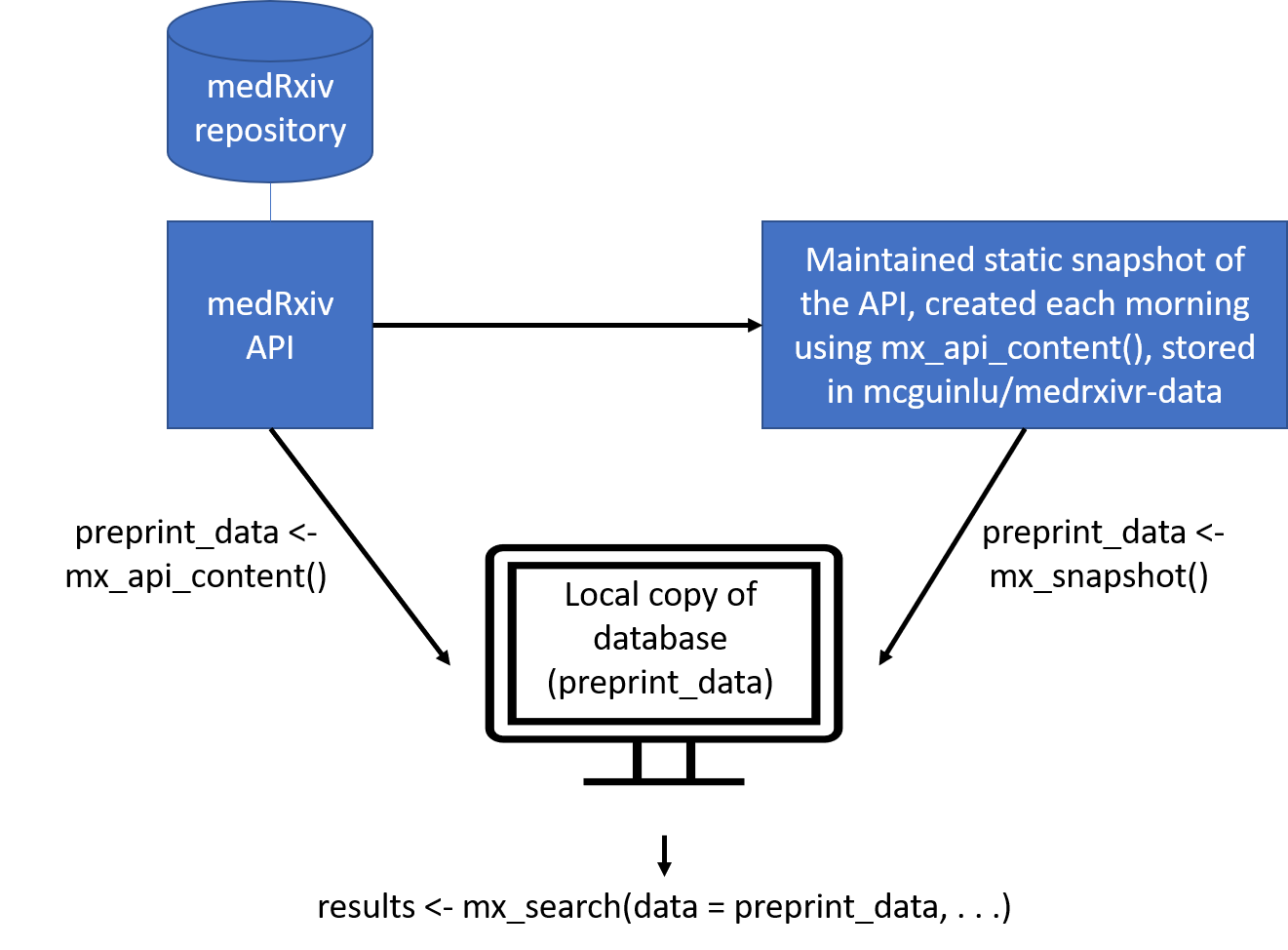
mx_api_content(server = "medrxiv")creates a local copy of all data available from the medRxiv API at the time the function is run.
# Get a copy of the database from the live medRxiv API endpoint
preprint_data <- mx_api_content() -
mx_snapshot()provides access to a static snapshot of the medRxiv database. The package reads a manifest from thesnapshotrelease assets for this repository, downloads the referenced compressed CSV files, and caches them locally. This method does not rely on the live API during ordinary use and is usually faster than re-extracting records from the API. The function prints the latest record date included in the snapshot; discrepancies between the most recent static snapshot and the live database can be assessed usingmx_crosscheck().
# Get a copy of the database from the static snapshot
preprint_data <- mx_snapshot()
The relationship between the two methods for the medRxiv database is summarised in the figure below:
bioRxiv data
Only one data source exists for the bioRxiv repository:
-
mx_api_content(server = "biorxiv")creates a local copy of all data available from the bioRxiv API endpoint at the time the function is run. Note: due to it’s size, downloading a complete copy of the bioRxiv repository in this manner takes a long time (~ 1 hour).
# Get a copy of the database from the live bioRxiv API endpoint
preprint_data <- mx_api_content(server = "biorxiv")
Performing your search
Once you have created a local copy of either the medRxiv or bioRxiv
preprint database, you can pass this object (preprint_data
in the examples above) to mx_search() to search the
preprint records using an advanced search strategy.
# Perform a simple search
results <- mx_search(data = preprint_data,
                     query ="dementia")

# Perform an advanced search
topic1  <- c("dementia","vascular","alzheimer's")  # Combined with Boolean OR
topic2  <- c("lipids","statins","cholesterol")     # Combined with Boolean OR
myquery <- list(topic1, topic2)                    # Combined with Boolean AND

results <- mx_search(data = preprint_data,
                     query = myquery)
Dataset description
The dataset (in this case, results) returned by the
search function above contains 14 variables:
| Variable | Description |
|---|---|
| ID | Unique identifier |
| title | Preprint title |
| abstract | Preprint abstract |
| authors | Author list in the format ‘LastName, InitalOfFirstName.’ (e.g. McGuinness, L.). Authors are seperated by a semi-colon. |
| date | Date the preprint was posted, in the format YYYYMMDD. |
| category | On submission, medRxiv asks authors to classify their preprint into one of a set number of subject categories. |
| doi | Preprint Digital Object Identifier. |
| version | Preprint version number. As authors can update their preprint at any time, this indicates which version of a given preprint the record refers to. |
| author_corresponding | Corresponding authors name. |
| author_corresponding_institution | Corresponding author’s institution. |
| link_page | Link to preprint webpage. The “?versioned=TRUE” is required, as otherwise, the URL will resolve to the most recent version of the article (assuming there is >1 version available). |
| link_pdf |
Link to preprint PDF. This is used by mx_download() to
download a copy of the PDF for that preprint.
|
| license | Preprint license |
| published | If the preprint was subsequently published in a peer-reviewed journal, this variable contains the DOI of the published version. |
Export records identified by your search to a .BIB file
medrxivr provides a helper function to export your
search results to a .BIB file so that they can be easily imported into a
reference manager (e.g. Zotero, Mendeley)
Download PDFs for records identified by your search
Pass the results of your search above (results) to the
mx_download() function to download a copy of the PDF for
each record.
mx_download(results,        # Object returned by mx_search
            tempdir(),      # Temporary directory to save PDFs to
            create = TRUE)  # Create the directory if it doesn't exist
Further guidance
Please see the medrxivr website vignette for extended guidance on developing search strategies and for detailed instructions on interacting with the Cold Springs Harbour API for medRxiv and bioRxiv.