
This vignette introduces rxp_pipeline(), a function for
organising large projects into logical sub-pipelines. This feature is
particularly useful when working on complex projects with multiple
phases (e.g., ETL, Modelling, Reporting) or when collaborating in teams
where different members work on different parts of the pipeline.
Large Pipelines Become Unwieldy
As pipelines grow, a single gen-pipeline.R file can
become difficult to manage. Consider a data science project with: - Data
extraction and cleaning (ETL) - Feature engineering - Model training -
Model evaluation - Report generation
Putting all derivations in one file makes it hard to:
- Navigate the code
- Understand which derivations belong to which phase
- Collaborate across team members
- Reuse pipeline components in other projects
To solve this issue, you can define your project using sub-pipelines
and join them into a master pipeline using
rxp_pipeline().
This allows you to:
- Organise derivations into named groups
- Colour-code groups for visual distinction in DAG visualisations
- Modularise your code across multiple R scripts
Basic Usage
A project with sub-pipelines would look something like this:
my-project/
├── default.nix           # Nix environment (generated by rix)
├── gen-env.R             # Script to generate default.nix
├── gen-pipeline.R        # MASTER SCRIPT: combines all sub-pipelines
└── pipelines/
    ├── 01_data_prep.R    # Data preparation sub-pipeline
    ├── 02_analysis.R     # Analysis sub-pipeline
    └── 03_reporting.R    # Reporting sub-pipeline
Each sub-pipeline file returns a list of derivations:
# Data Preparation Sub-Pipeline
# pipelines/01_data_prep.R
library(rixpress)

list(
  rxp_r(name = raw_mtcars, expr = mtcars),
  rxp_r(name = clean_mtcars, expr = dplyr::filter(raw_mtcars, am == 1)),
  rxp_r(name = selected_mtcars, expr = dplyr::select(clean_mtcars, mpg, cyl, hp, wt))
)
The rxp_pipeline() function takes:
- name: A descriptive name for this group of derivations
- path: Either a file path to an R script returning a list of derivations (recommended), or a list of derivation objects.
- color: Optional CSS color name or hex code for DAG visualisation
The second sub-pipeline:
# Analysis Sub-Pipeline
# pipelines/02_analysis.R
library(rixpress)

list(
  rxp_r(name = summary_stats, expr = summary(selected_mtcars)),
  rxp_r(name = mpg_model, expr = lm(mpg ~ hp + wt, data = selected_mtcars)),
  rxp_r(name = model_coefs, expr = coef(mpg_model))
)
The master script becomes very clean, as rxp_pipeline
handles sourcing the files:
# gen-pipeline.R
library(rixpress)

# Create named pipelines with colours by pointing to the files
pipe_data_prep <- rxp_pipeline(
  name = "Data Preparation",
  path = "pipelines/01_data_prep.R",
  color = "#E69F00"
)

pipe_analysis <- rxp_pipeline(
  name = "Statistical Analysis",
  path = "pipelines/02_analysis.R",
  color = "#56B4E9"
)

# Build combined pipeline
rxp_populate(list(pipe_data_prep, pipe_analysis), project_path = ".", build = TRUE)
Visualising Sub-Pipelines
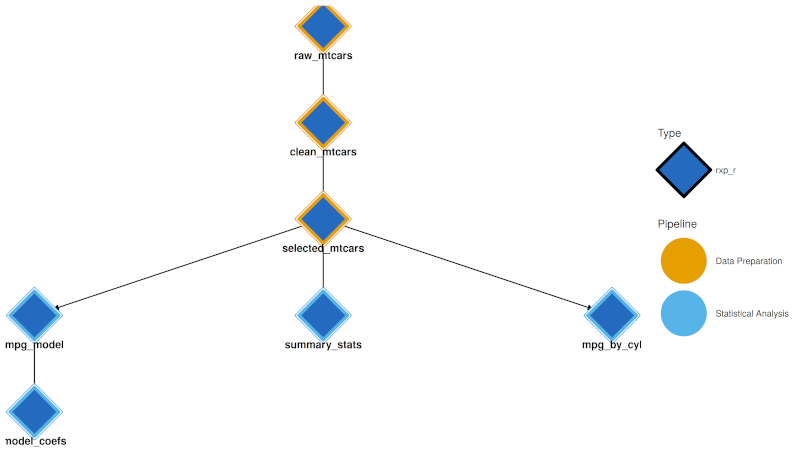
When sub-pipelines are defined, visualisation tools use pipeline colours:
-
Interactive Network (
rxp_visnetwork()) and Static DAG (rxp_ggdag()) both use a dual-encoding approach:- Node fill (interior): Derivation type colour (R = blue, Python = yellow, etc.)
- Node border (thick stroke): Pipeline group colour This allows you to see both what type of computation each node is and which pipeline it belongs to.
-
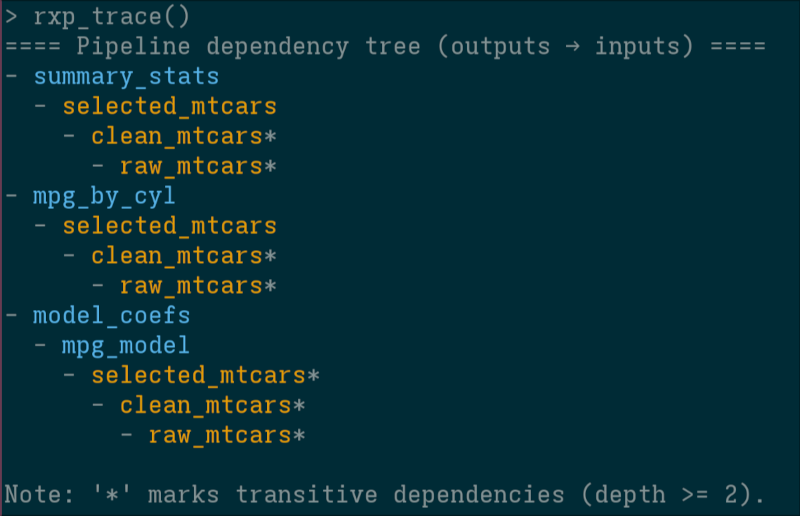
Trace:
rxp_trace()output in the console is coloured by pipeline (using theclipackage).
How It Works Internally
When you call rxp_populate() with
rxp_pipeline objects:
- Flattening: Pipelines are flattened to a single list of derivations
-
Metadata Preservation: Each derivation retains
pipeline_groupandpipeline_color -
DAG Generation:
dag.jsonincludes pipeline metadata -
Visualisation:
rxp_visnetwork()andrxp_ggdag()read this metadata
Best Practices
- Use descriptive pipeline names: “Data Preparation” is better than “ETL”
- Choose contrasting colours: Use ColorBrewer palettes
- Keep sub-pipelines focused: One logical phase per sub-pipeline
- Order your files: Use numeric prefixes (01_, 02_, etc.)
Conclusion
rxp_pipeline() provides a simple yet powerful way to
organise complex pipelines. By grouping derivations into logical units,
you can:
- Keep your code organised and maintainable
- Enable team collaboration on different parts of the pipeline
- Visualise the structure of your workflow with meaningful colours
- Reuse sub-pipelines across projects
For a working example, see the subpipelines demo in the
rixpress_demos
repository.